In the world of discrete mathematics, digital electronics, and computer science, optimization is everything. When you are building a complex system based on logic gates, the initial mathematical formula derived from a truth table often turns out to be excessively long. This is exactly where Karnaugh maps step onto the stage. As the most elegant visual tool available, maps are essential for simplifying Boolean expressions and finding the Minimal Disjunctive Normal Form (MDNF).
In this definitive guide, we will dive deep, how the DNF minimization algorithm works, and why Gray code is the secret engine behind this method. Whether you are studying for an exam or designing logic circuits.
1. What are Karnaugh Maps and Why Do We Need Them?
The Karnaugh map (frequently abbreviated as K-map) is a graphical method used to minimize Boolean functions. According to the history of Karnaugh maps, the method was invented in 1953 by Maurice Karnaugh, a telecommunications engineer. Visually, a Karnaugh map is essentially a standard truth table that has been “folded” into a two-dimensional grid.
When dealing with a complex logical function, we can write it down in its Perfect Disjunctive Normal Form (PDNF). Every single row in a truth table where the function evaluates to $1$ is transformed into a long product. If your truth table has many $1$s, your formula becomes a gigantic mathematical monster.
The primary goal is to find the MDNF (Minimal Disjunctive Normal Form). In the realm of microelectronics, a smaller formula translates to fewer physical microchips, reduced energy consumption, and faster processing speeds. If you want to learn more about the foundation of these concepts, check out our beginner’s guide to discrete mathematics and Boolean algebra (Примітка: замініть це посилання на реальне посилання з вашого блогу).
Boolean Algebra vs. Karnaugh Maps
You might wonder: “Can’t we just use regular math to simplify these equations?” Yes, you can use algebraic laws. However, algebraic simplification is prone to human error. Karnaugh maps eliminate this guesswork. By relying on human visual pattern recognition, Karnaugh maps guarantee that you will find the most optimal solution every single time.
The Secret Engine of Karnaugh Maps: Gray Code Magic
The ultimate superpower of Karnaugh maps lies in how their columns and rows are numbered. Instead of using standard binary counting ($00, 01, 10, 11$), Karnaugh maps use Gray Code: $00 \to 01 \to 11 \to 10$.
In Gray code, any two adjacent cells differ by the value of strictly one variable. If two adjacent grid cells in Karnaugh maps both contain a $1$, the variable that changes its state between those two cells simply “cancels out”, instantly simplifying the expression.
2. The Golden Rules: How to Group 1s in Karnaugh Maps
To master DNF minimization using Karnaugh maps, our objective is to combine cells containing ones ($1$) into specific blocks. There are strict rules to Karnaugh maps; breaking them will inevitably lead to an incorrect result:
- Rectangles and Squares Only: Groups in Karnaugh maps can only be formed in the shape of proper rectangles or squares. Creating L-shaped groups or zigzags is strictly forbidden!
- The Power of Two Rule: The number of ones enclosed inside every designated group must strictly be a power of two: $1, 2, 4, 8, 16$.
- Bigger is Always Better: The larger the group you create in your Karnaugh maps, the more variables will be canceled out. A group of 4 is vastly superior to two separate groups of 2.
- Overlapping is Allowed: Groups can overlap. A single $1$ on Karnaugh maps can belong to multiple different groups simultaneously.
- Toroidal Topology: Karnaugh maps do not have hard edges. The right edge of the map mathematically “wraps around” and connects to the left edge. Ones located in the four corners are considered adjacent!
3. Practical Walkthrough: 3-Variable Karnaugh Maps
To make the theory clear, let’s break down a classic 3-variable example using Karnaugh maps: $f(x, y, z)$.
Suppose our function evaluates to $1$ only for the following input sets:
- $000$ ($\neg x \neg y \neg z$)
- $001$ ($\neg x \neg y z$)
- $010$ ($\neg x y \neg z$)
- $100$ ($x \neg y \neg z$)
- $101$ ($x \neg y z$)
Step 1: Draw and Populate
For a 3-variable system, Karnaugh maps look like a $2 \times 4$ table. We plot our five ones ($1$) into their corresponding coordinate cells:
| $z \backslash xy$ | 00 | 01 | 11 | 10 |
|---|---|---|---|---|
| 0 | 1 | 1 | 0 | 1 |
| 1 | 1 | 0 | 0 | 1 |
Step 2: Grouping in Karnaugh Maps
Group 1: By utilizing the “wrap-around” rule of Karnaugh maps, we can combine the four ones located at the extreme left and right columns into one large square: $(00,0), (00,1), (10,0), (10,1)$.
Group 2: We have exactly one unassigned $1$ left at coordinate $(01,0)$. We group it with its neighbor to the left $(00,0)$ to form a 2-cell group.
Step 3: Extract the MDNF
The primary rule for writing down the formula from Karnaugh maps is: “What changes gets destroyed. What remains stable is kept.”
- Group 1 Analysis: $x$ changes from $0$ to $1$, so it is eliminated. $y$ remains a stable $0$ ($\neg y$). $z$ fluctuates and gets destroyed. Result: $\neg y$.
- Group 2 Analysis: Variable $x$ is a stable $0$ ($\neg x$). Variable $y$ changes. $z$ is stable at $0$ ($\neg z$). Result: $\neg x \neg z$.
The Final Answer:
$$MDNF = \neg y \lor (\neg x \wedge \neg z)$$
4. Mastering 4-Variable
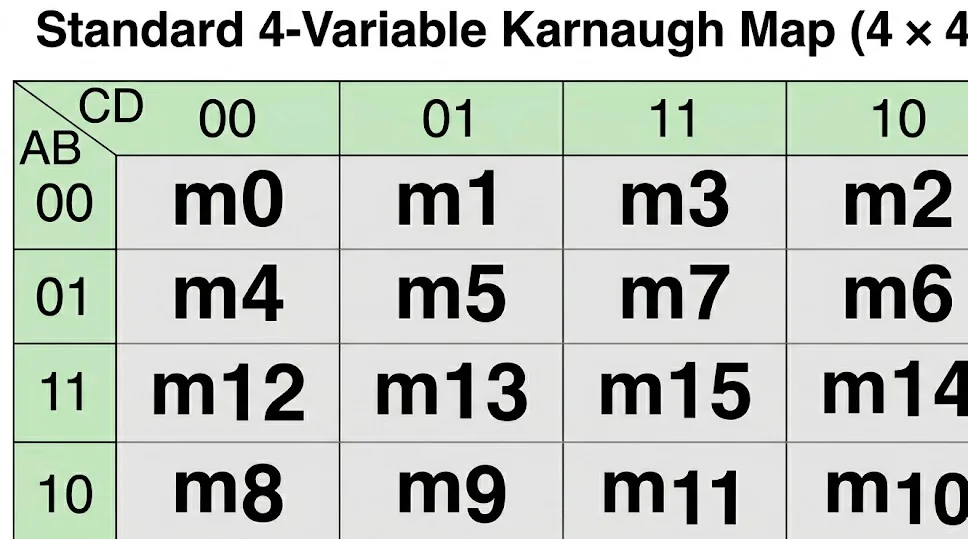
In computer science exams, you will most frequently encounter 4-variable: $f(A, B, C, D)$. This requires a $4 \times 4$ matrix.
Let’s assume we have a function with ones at the following minterms: $m(0, 2, 4, 6, 8, 10, 12, 14, 15)$.
| $AB \backslash CD$ | 00 | 01 | 11 | 10 |
|---|---|---|---|---|
| 00 | 1 | 0 | 0 | 1 |
| 01 | 1 | 0 | 0 | 1 |
| 11 | 1 | 0 | 1 | 1 |
| 10 | 1 | 0 | 0 | 1 |
Step 2: Grouping in 4-Variable
- Group 1: Look closely at the columns $CD=00$ and $CD=10$. By utilizing the wrap-around rule inherent, we can fold the map and merge these two columns into a massive group of 8 ones! The extracted term is $\neg D$.
- Group 2: There is one lone $1$ left at $(11, 11)$. We group it with its neighbor to the right $(11, 10)$ to form a pair. The extracted term is $A B C$.
Final Result: $$MDNF = \neg D \lor (A \wedge B \wedge C)$$
5. Advanced Edge Cases: “Don’t Care” Conditions in Karnaugh Maps
Frequently, in Karnaugh maps problems, you will encounter grid cells marked with an “X” or a “d”. These represent “Don’t Care” conditions.
These X marks are your secret weapons in Karnaugh maps. They act like wildcards. You can choose to treat them as ones ($1$) if including them allows you to create a significantly larger group on your Karnaugh maps. Conversely, you are not obligated to loop them. You only group them when it provides a strategic mathematical advantage.
6. Real-World Applications
Why do computer science students spend hours learning Karnaugh maps? Because they are foundational for modern computing:
- Digital Logic Design: Engineers use maps to optimize the logic gate pathways in ASICs and FPGAs.
- PLC Programming: Complex sensor logic is simplified using maps to prevent system conflicts.
- Software Condition Optimization: Senior developers translate deeply nested
if-elseconditions into Karnaugh maps to refactor messy logic.
7. Frequently Asked Questions (FAQ)
Can I group 6 ones together?
No. You can only group ones in powers of two ($1, 2, 4, 8, 16$). A group of 6 must be split into overlapping groups.
What happens if a $1$ cannot be grouped?
If a $1$ is completely isolated on Karnaugh maps, you must loop it by itself (a group of 1).
Are maps useful for 5 or 6 variables?
Yes, but they become visually extremely complex. For anything beyond 4 variables, engineers typically abandon manual maps and use software algorithms like the Quine-McCluskey method.
Conclusion
The ultimate takeaway for developers: The more ones ($1$s) you can successfully trap inside a single valid group, the fewer variables will remain in your final MDNF expression. Karnaugh maps brilliantly visualize abstract Boolean algebra, transforming tedious mathematical reduction into an engaging graphic puzzle.