Welcome to Review Space
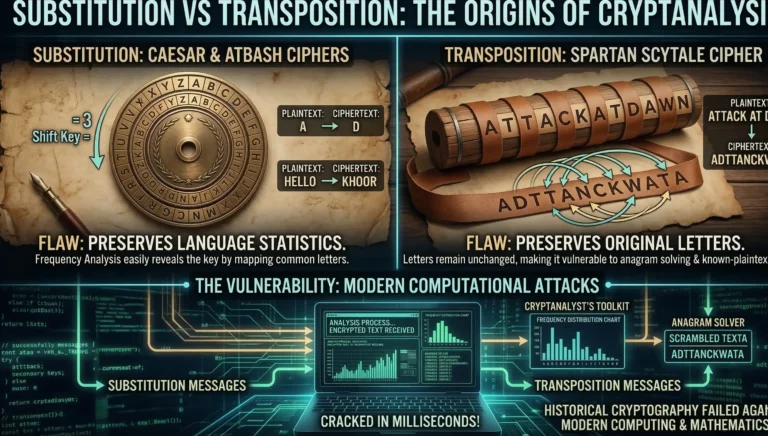
A detailed infographic explaining the mechanical differences between a substitution vs transposition cipher. It compares Caesar cipher modular arithmetic using a cipher wheel with Spartan Scytale cryptography, highlighting their devastating historic flaws.
Cryptography Mar 13 8 min

Substitution vs Transposition Cipher: 3 Devastating Historic Flaws

When analyzing the evolution of secure digital communications, modern engineers often overlook the foundational lessons of the past.…
Read More →
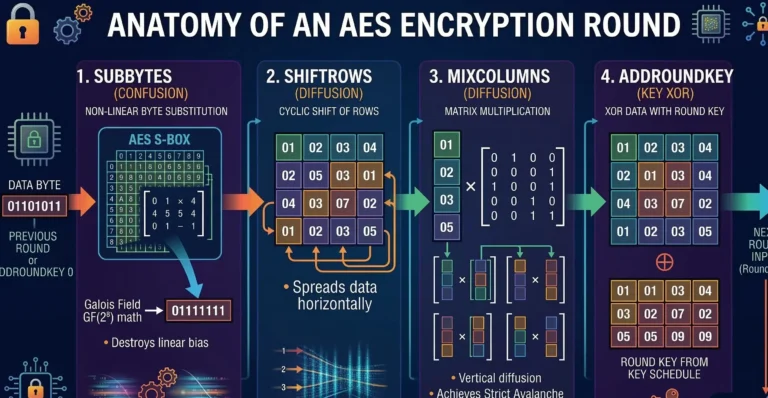
An architectural diagram of an AES encryption round. It illustrates how non-linear AES S-box mathematics prevents linear cryptanalysis explained in earlier sections. The MixColumns and ShiftRows layers demonstrate how the cipher achieves perfect avalanche effect cryptography, completely neutralizing the threat of differential cryptanalysis.
Cryptography Mar 13 6 min

Differential Cryptanalysis: 5 Fatal Threats & Proven AES Defenses

Understanding differential cryptanalysis is the absolute pinnacle of modern cybersecurity engineering. In our previous modules, we explored how…
Read More →
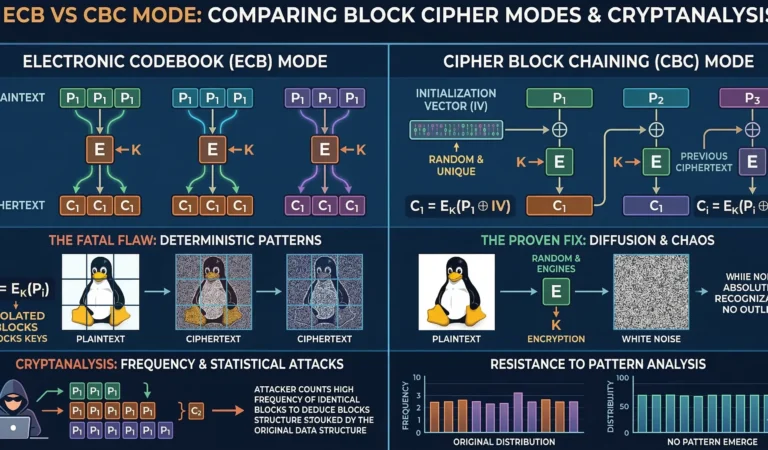
An architectural infographic comparing ECB vs CBC mode. It illustrates how statistical cryptanalysis easily breaks Electronic Codebook due to deterministic patterns (the visible penguin). Conversely, it shows how Cipher Block Chaining uses initialization vector cryptography to diffuse data into secure white noise, highlighting the critical differences in block cipher modes of operation.
Cryptography Mar 13 8 min

ECB vs CBC Mode: 5 Fatal Cryptanalysis Mistakes & Proven Fixes

Before diving into the deep statistical analysis of cryptographic vulnerabilities, we must understand a fundamental mathematical phenomenon known…
Read More →

A detailed infographic explaining birthday paradox cryptography and hash collision probability. It visually breaks down a complete birthday attack explanation, showing how 23 people create a 50% match chance, the mathematics of an MD5 collision, and why effective cryptographic security is halved.
Cryptography Mar 12 7 min

Birthday Paradox Cryptography: 5 Critical Hash Collision Facts

Birthday paradox cryptography is the absolute mathematical foundation for understanding how digital signatures, blockchain ledgers, and password storage…
Read More →
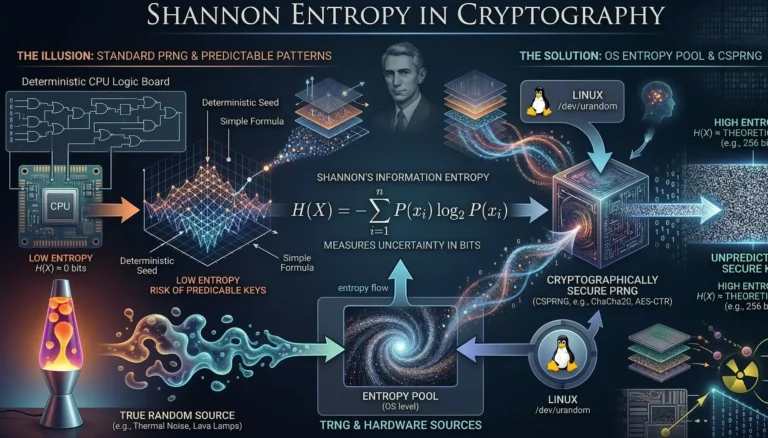
A detailed architectural infographic explaining Shannon entropy in cryptography. The left side illustrates the deterministic flaw of standard PRNGs leading to predictable keys with low entropy. The center and right sides demonstrate the secure solution: combining true random sources into an OS entropy pool. This pool feeds Linux /dev/urandom and powers a Cryptographically Secure Pseudo-Random Number Generator (CSPRNG) to create unpredictable, high-entropy cryptographic keys.
Cryptography Mar 12 7 min

Shannon Entropy in Cryptography: 5 Critical Rules for Secure Keys

Understanding Shannon entropy in cryptography is not just an academic exercise; it is the absolute foundation of modern…
Read More →
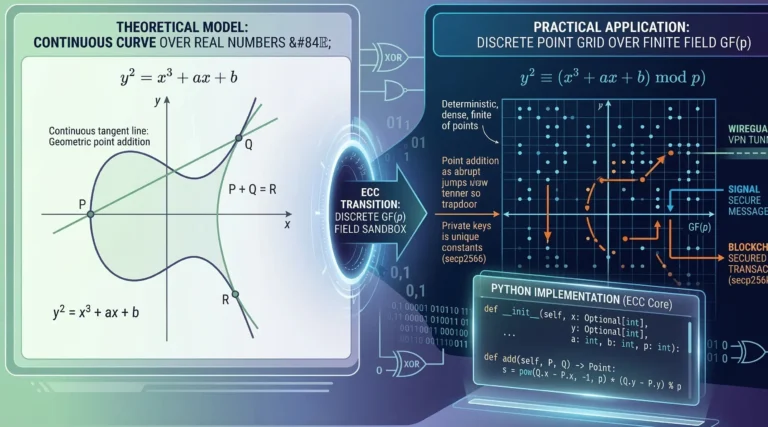
Detailed educational infographic comparing the theoretical continuous mathematics of elliptic curves with their practical application in discrete elliptic curve cryptography (ECC) over finite fields. The left panel shows a continuous curve ($y^2 = x^3 + ax + b$) demonstrating geometric point addition. A transition portal leads to the right panel illustrating a discrete point grid over a finite field GF(p) with modulo p arithmetic, explaining how points hop deterministically. This discrete property creates a secure 'trapdoor' function used in blockchain security (secp256k1), WireGuard VPN tunnels, and Signal messaging. A foreground element features a Python implementation (ECC Core) with code examples for initialization and point addition, showcasing the crucial use of modular inverse calculations.
Cryptography Mar 10 9 min

7 Brilliant Secrets of Elliptic Curve Cryptography & ECC

Finite Fields in Elliptic Curve Cryptography (ECC): From Theory to Practice Modern digital security is undergoing a fundamental…
Read More →
Privacy
We respect your privacy. We use cookies for analytics and marketing purposes to improve your experience. Read more.
Preferences

Data Preferences

×

Strictly Necessary

Required for the site to function properly.

Analytics & Marketing

Google Analytics 4, Meta (Facebook) Pixel.